Stinging insect colonies present distinct structural risks across Baltimore's historic architecture, particularly where century-old wooden soffits, decorative roofline brackets, and shared rowhouse brick party walls…
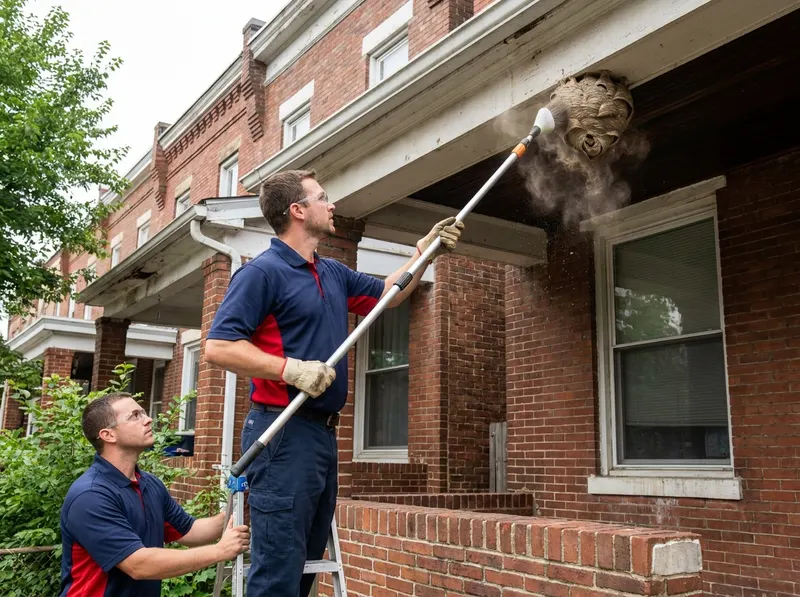
Stinging insect colonies present distinct structural risks across Baltimore's historic architecture, particularly where century-old wooden soffits, decorative roofline brackets, and shared rowhouse brick party walls offer sheltered voids. In dense neighborhoods such as Federal Hill, Fells Point, and Canton, umbrella paper wasps exploit gaps beneath standing-seam porch tin and exterior deck framing, while aggressive yellow jacket colonies frequently establish nests behind deteriorating mortar lines or inside unsealed crawlspace vents. Ground-level hornets and subterranean yellow jackets in Roland Park and Hampden yards create severe territorial sting risks within 10 to 15 feet of footpaths and garden perimeters.
Selecting professional stinging insect nest removal over retail spray cans eliminates the severe hazard of flushing defensive insects into the living space. When aerosols are discharged into exterior brick weeps or attic vents in historic Mount Vernon or Bolton Hill properties, yellow jackets routinely chew through degraded lath, plaster, or drywall, entering bedrooms and hallways rather than exiting outside. A mechanical extraction and pyrethrin-based barrier protocol addresses both the active insect mass and the brood comb, preventing secondary scavenger infestations from carpet beetles and rodents that feed on abandoned organic comb material.
Structural execution follows three numbered steps. First, technicians inspect the building envelope to locate the primary foraging aperture and determine if the nest structure extends into wall cavities or cornice framing. Second, targeted thermal tracking and micro-injection agents neutralize the colony directly at the nucleus without saturating living spaces or exposing indoor pets to broad-spectrum drift. Third, the physical carton and comb are extracted where architecturally accessible, followed by the application of an inorganic silica-based dust to discourage scout queens from reusing the void in subsequent seasons. Service within Charles Village, Locust Point, and Patterson Park accounts for narrow property lines, ensuring adjacent rowhouse occupants remain undisturbed during application.
Every job gets a firm, written price after a free on-site visit.
Tell us about your stinging insect nest removal job in Baltimore and we'll send a clear, written quote, usually the same day.
 Elvaris Pest Solutions