Connected historic masonry defines Baltimore City residential housing, meaning an active rodent discovery in one address regularly stems from a structural opening three properties away along a continuous row. Norway…
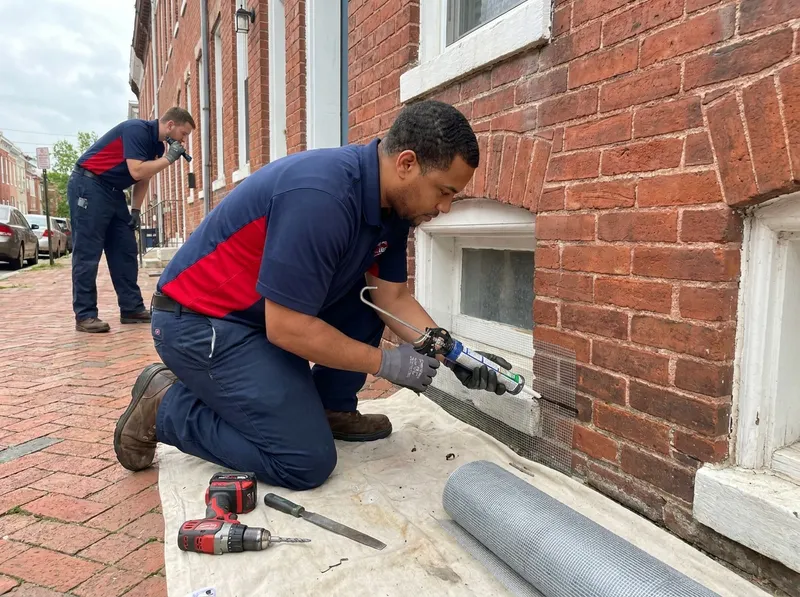
Connected historic masonry defines Baltimore City residential housing, meaning an active rodent discovery in one address regularly stems from a structural opening three properties away along a continuous row. Norway rats navigate exterior alley lines and subterranean utility tunnels, chewing through degraded lime mortar, open crawlspace vents, and hollow wooden doorframes. In neighborhoods like Canton, Fells Point, and Federal Hill, high-density brick structures share continuous party walls with void spaces behind lath-and-plaster. When moisture weakens historic foundation joints, rodents access wall cavities, producing persistent scratching sounds above ceilings and causing chewing damage to electrical wiring and plumbing lines. Standard surface treatments like snap traps and temporary anticoagulant rodenticide bait blocks provide short-term suppression, but they do not stop fresh rodents from entering through exterior voids.
Structural exclusion establishes a permanent barrier between the domestic interior and shared alleyway ecosystems. In historic districts such as Mount Vernon, Bolton Hill, and Charles Village, masonry foundations settle over decades, producing structural separations between granite footings, subfloor timbers, and cast-iron drain lines. Mice require only a 1/4-inch opening, while adult Norway rats penetrate gaps measuring 1/2 inch across. The exclusion protocol inspects the interior perimeter, attic eaves, downspout bases, and basement crawlspaces, sealing gaps with galvanized 19-gauge steel hardware cloth, high-density copper mesh, hydraulic cement, and silicone-based barriers that rodents cannot gnaw through. This structural approach eliminates reliance on open poison formulations inside primary living areas, preventing risks to indoor domestic pets and infants.
Properties in Hampden, Patterson Park, and Locust Point frequently feature wood-frame additions or rear alley porches built over exposed dirt crawlspaces. These structural transition zones serve as primary rodent runways into subfloor insulation. For detached or stone foundation estates in Roland Park, subterranean burrow systems beneath flagstone patios demand exterior barrier trenches alongside internal basement sealing. A focused, single-point pipe penetration seal costs $200 to $350 and resolves an isolated kitchen sink breach. In contrast, comprehensive multi-level exclusion, addressing interconnected roof parapets, subfloor voids, and crawlspace framing, ranges up to $1,800. The mechanical barrier removes the biological vector at the structural perimeter, restoring quiet, sanitary security to the home.
Every job gets a firm, written price after a free on-site visit.
Tell us about your rowhouse rodent exclusion job in Baltimore and we'll send a clear, written quote, usually the same day.
 Elvaris Pest Solutions