Connected historic masonry rowhouses in Baltimore create subterranean and wall-void runways that allow foraging ants to move between properties. In neighborhoods like Canton, Fells Point, and Federal Hill, moisture…
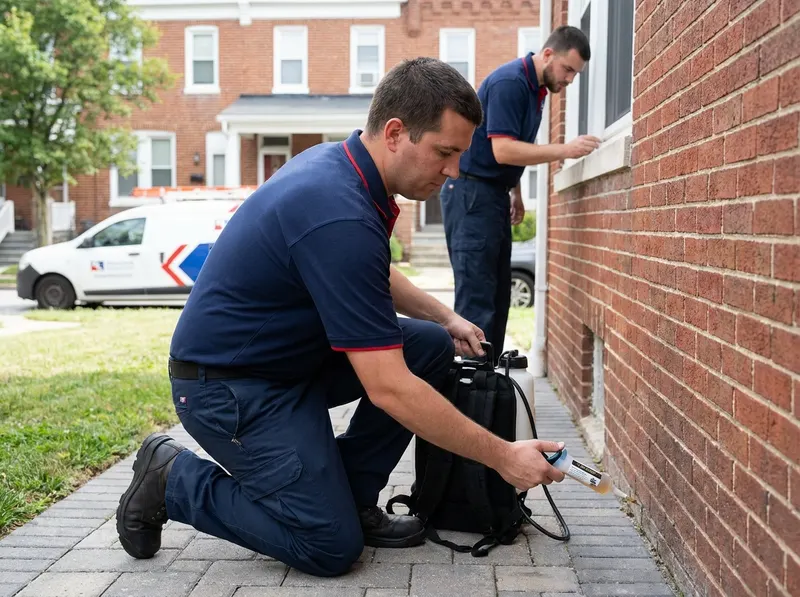
Connected historic masonry rowhouses in Baltimore create subterranean and wall-void runways that allow foraging ants to move between properties. In neighborhoods like Canton, Fells Point, and Federal Hill, moisture issues in aging brick party walls and rubblestone foundations provide ideal microclimates for pavement ants and odorous house ants. Generic repellent sprays disperse these colonies into satellite nests throughout adjacent subflooring. An architectural approach uses slow-acting, non-repellent matrixes placed directly along confirmed transit trails. Foragers consume the bait and transfer the active ingredient through trophallaxis to the queen deep inside structural timbers or exterior subsoil, collapsing the reproductive center of the colony within 7 to 21 days.
Exterior treatments require adjustments based on Baltimore's local building typologies. In historic neighborhoods like Bolton Hill, Mount Vernon, and Charles Village, where brick facades meet municipal sidewalks, high-retention microencapsulated formulations are applied directly to mortar joints, window lintels, and basement light wells up to 3 feet from the foundation base. In detached residences found in Roland Park or Hampden, exterior treatment extends to garden perimeter interfaces, mulch lines, and service pipe penetrations. The defensive perimeter prevents re-infestation while existing indoor workers complete bait transfer.
Homeowners selecting ant management face a clear mechanical trade-off: fast-knockdown pyrethroid sprays kill visible surface foragers in minutes but preserve the subterranean queen, guaranteeing a resurgence within 30 days; non-repellent baiting keeps workers alive for 48 to 72 hours so they can return toxics to the nest, eliminating the biological source at the expense of instant dead-bug visibility. All deployed bait stations use tamper-resistant, enclosed matrixes secured within wall voids, beneath appliances, or inside moisture-dense utility chases, ensuring zero physical contact with domestic pets, children, or food surfaces.
Every job gets a firm, written price after a free on-site visit.
Tell us about your ant colony baiting & perimeter defense job in Baltimore and we'll send a clear, written quote, usually the same day.
 Elvaris Pest Solutions